
TLDR: When a buyer searches “hot tub store near me,” your dealership isn’t only competing with the dealer across town. You’re competing with directories and manufacturer dealer locators that list every dealer on one page. The fix is a dedicated page for each physical location, a Google Business Profile that points to it, and a steady flow of fresh reviews.
—
I keep hearing this complaint come up over and over again… Jacuzzi’s corporate website is outranking me, or the dealer locator page on Caldera Spas is outranking me and I’m scared they are sending traffic to my competitors. How do I fix this?
I decided to run a handful of searches this morning for terms like “hot tub store near me” and “hot tub dealer near me” and looked at what came back below the map pack. We’re talking about true, organic rankings here.
Here’s what I found… directory and listing sites took a big share of the first page. In one search, two manufacturer dealer locators sat on page one too, and one of them held the top spot. Dealers were in the results, but they were sporadic and fighting for visibility.
My take is that most dealers think they’re ONLY competing with the shop across town. They’re ALSO competing with pages built to list every dealer in one place. Both are a problem, but let’s unpack the latter.
The Searches That Matter
According to Semrush, “hot tubs near me” gets about 22,200 searches a month in the US. “Hot tub near me” gets about 9,900, “hot tub store near me” about 6,600, and “hot tub stores near me” about 4,400. “Hot tub dealers near me” gets about 3,600.
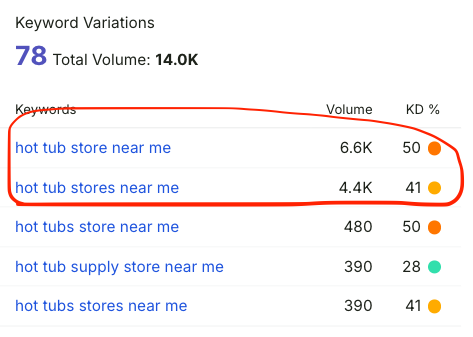
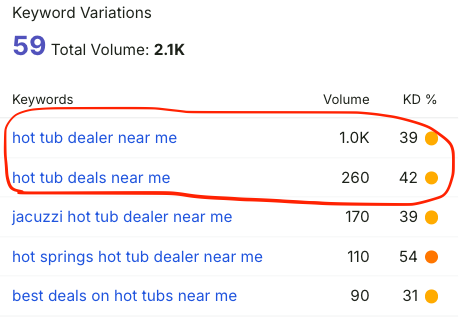
As you can see, buyers say “store” far more than they say “dealer.”
Use the buyer’s language on your pages, not the industry’s. This is a big unlock. These people are close to visiting a showroom, and whoever owns that result gets the first conversation.
Why Directories and Locators Win
Directories have huge domain authority (trust) and thousands of pages. Manufacturer locators sit on big brand websites… and big brand websites rank extremely well! They just give Google a list, and a list is easy to rank. It’s kind of not fair, right?
I’m not saying you can’t beat them.
In the same searches, dealers with a dedicated page for one specific location showed up on page one as well. The pattern I noticed is that those pages were built around one city and one store, not around a single homepage trying to cover every market. This is key.
One Page for Every Physical Location
My rule is simple: a dealer should have a city-specific page only if they have a physical location there. Three stores means three pages. Each one is optimized for the keyword variations of that city, and each one includes the following:
- A few hundred words of original text. Talk about where you’re located in the community and the surrounding areas you serve. Name nearby cities briefly here, instead of building a separate page for each. Make sure to write this yourself. You need to stand out and look different than your competitors.
- A bulleted list of what that store sells. Make sure to include a list of what you sell, such as hot tubs, saunas, cold plunges, swim spas, patio furniture, whatever applies. Link each bullet to the matching landing page. That helps buyers get to the product they want and passes internal link strength to the pages that sell.
- Real photos of that store and team, plus hours, directions, and an embedded map.
- Reviews from that location.
If you’ve read any of my other posts or watched any of my videos, you might be thinking, won’t these pages be too closely related to each other?
Why this isn’t the copy-and-paste problem: Google’s spam policy targets large amounts of unoriginal content. A page for a real store, written for that community, is the opposite. A page for every suburb with the city name swapped in is the thing to avoid. I covered that risk in the blog post I published last week called Google Is Telling You Something About Copy-and-Paste Content. You should check it out.
Connect Your Google Business Profile to the Page
Each location’s Google Business Profile (map listing) should link to its own location page, not the homepage. This is a very common problem I see with most dealers that I audit. Add UTM parameters so you can see in analytics how much traffic and how many calls come from the profile. The full profile checklist is in the blog post I wrote called Your Hot Tub Dealership Isn’t Losing the Map Pack, so I won’t repeat it here.
Keep the Reviews Coming
This is a non-negotiable… Set up an automatic text or email after every delivery or service visit, and send it every week, not in one push. Reply to every review, good or bad. Review velocity and owner responses are critical to showing up high in the map pack.
You also need to keep your business name, address and phone number identical across your website, your profile, and every directory listing. Why that also matters for AI search is in the blog post I wrote called What ChatGPT Says When Someone Asks for the Best Hot Tub Dealer in Your City.
What to Do This Week
So, let me break it down really easy for you on how to tackle this in the next 5 business days.
- Run a search “hot tub store near me” from your showroom in an incognito window and note who ranks above you.
- Check that every location has its own page, and that you can find it on Google.
- Review the content and rewrite thin location pages to the standard outlined above.
- Point each Google Business Profile link at its own location page.
- Turn on the automatic review request.
If you have five minutes today, I would recommend starting with step 4. It takes 5-10 minutes, and it connects everything else.
Go get ‘er done!
FAQs
Do I need a page for every city I serve?
No. Build a page for each physical location. Mention the surrounding cities you serve on that page, briefly.
Can I really rank above a manufacturer’s dealer locator?
It’s possible. A locator gives Google a list. A strong page for your specific store gives Google a more useful answer for that city. Dealers with dedicated location pages did appear on page one in the searches I ran.
How long does a location page take to rank?
It depends on your site’s authority and the competition in your market. A good rule is to give it about 90 days, and sooner if your Google Business Profile is also improving.
How many reviews do I need?
There’s no magic number. What matters is that new reviews keep arriving, and that you reply to them. Aim for steady, not a one-time burst.
Should my Google Business Profile link to my homepage?
For a single-location dealer the homepage can work. For several locations, link each profile to its own location page.

Greg is the founder and CEO of Stryde and a seasoned digital marketer who has worked with thousands of businesses, large and small, to generate more revenue via online marketing strategy and execution. Greg has written hundreds of blog posts as well as spoken at many events about online marketing strategy. You can follow Greg on Twitter and connect with him on LinkedIn.
