
TLDR: Most hot tub and pool dealers wait too long to start their SEO push before peak season. National search data shows interest builds steadily through fall and winter and actually peaks in spring, March through June, not a sharp January spike like a lot of people assume. As a general rule, meaningful organic movement takes about 90 days, and Google Business Profile improvements can move faster, in the 6 to 8 week range. Getting there starts with real competitive research, not guesswork.
—
One of the questions I get asked constantly by hot tub and above-ground pool dealers is some version of the same thing…
How early should I start the SEO for a hot tub dealership before peak season hits? It’s a fair question, and it deserves a direct answer. IMO… as a general rule, you need about 90 days to really start having a strong influence over your organic keyword rankings and your positioning in AI Overviews and platforms like ChatGPT and Gemini.
I’ve seen some sites move faster than that, and I’ve seen some take longer depending on how much existing authority and prior SEO work the site already has behind it.
What the Data Actually Shows
I pulled Google Trends data going back over two decades to look at how search interest for “hot tub” actually moves throughout the year, and it doesn’t quite match the assumption a lot of people carry around. The common belief is that people start aggressively searching in January and that interest peaks sometime in late February or mid-March. That’s not quite what the data shows.
Averaged out over the last several years, national search interest bottoms out in August and September. From there, it climbs steadily through the fall and into winter. January and February are elevated compared to that late-summer low, but they’re still on the way up, not at the top. The actual peak sits in spring, March through June, before the whole curve starts declining again over the summer months.
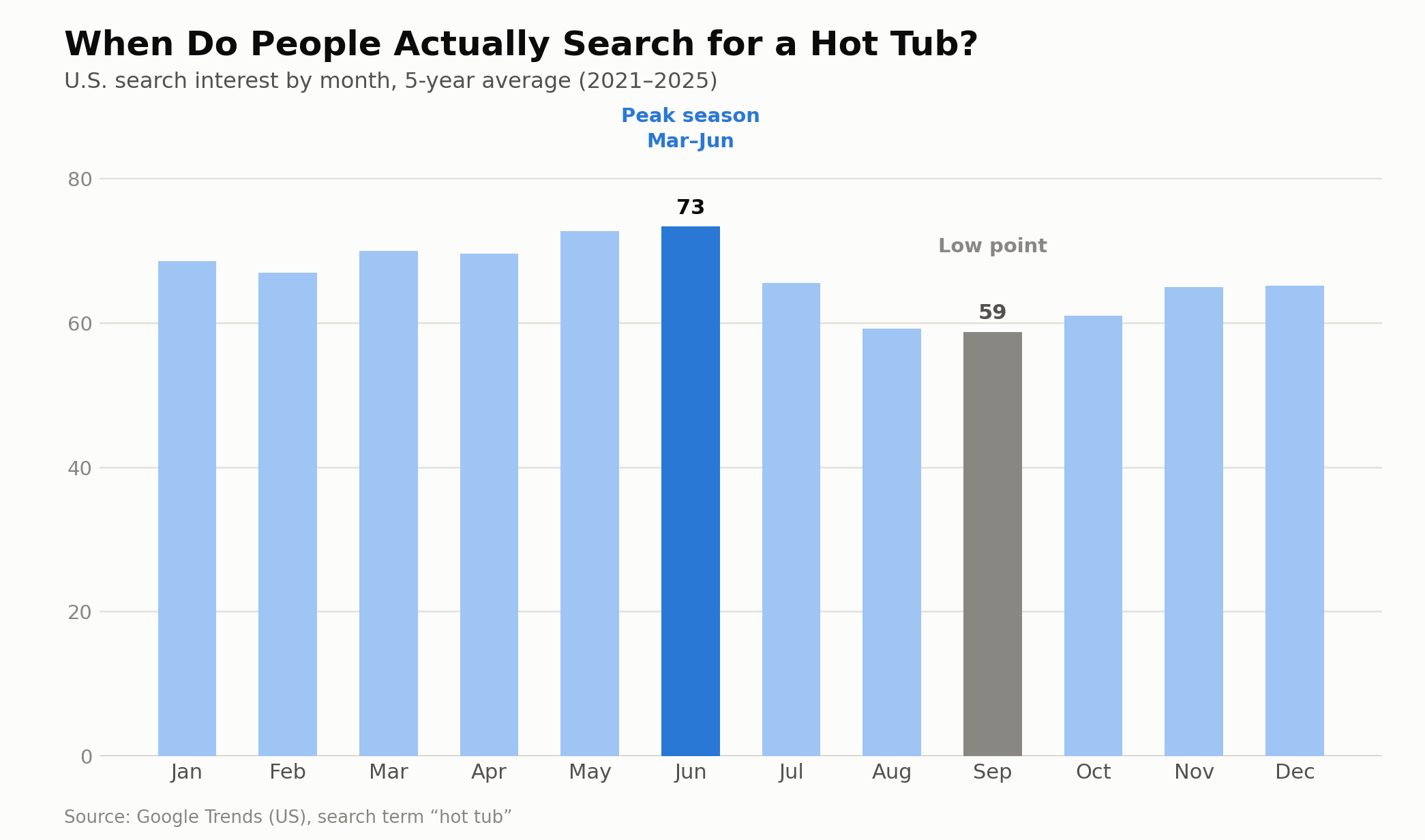
That distinction matters more than it might seem. If a dealer is aiming to be fully positioned for that spring peak with a real 90-day head start, the work needs to start around November or December, not after the new year. Waiting until January to begin means having to play catch up after a chunk of the buildup has already happened. Catch up = way more expensive.
Know Your Own Peak Season, Not Just the National Curve
National trend data is a useful reference point, but it’s not a substitute for a dealer’s own numbers. Any good dealer should already know when their real peak season hits, based on their own historical sales and lead data. That’s the actual source of truth here, not a national chart.
Regional differences matter too.
A dealer in Colorado is going to see buying interest shift earlier than a dealer in Arizona, simply based on when the weather turns. The national curve tells you the general shape of demand across the country. Your own sales history tells you when your specific market actually moves. So tap into that in order to make strong strategic decisions.
Once we know when to start, let’s break down the actual process of building the strategy.
Step 1: Competitive Analysis Before Anything Else
Before any real SEO campaign starts, the first move should always be a hard look at the competition. Google or ChatGPT are giving them preference for a reason; let’s figure out why.
Identify the top three sites currently ranking for the keywords you want to own, and dig into why Google is favoring them. How much content do they actually have on the page? What do their core optimizations look like: title tags, heading structure, how naturally keywords are worked into the copy throughout the page?
It’s just as important to look at how they’re optimizing for generative AI. Are they including FAQs on their pages? Is their content structured in a way that makes it easy for an LLM or Google to pull out specific pieces to answer a buyer’s question directly? That structure is increasingly what separates the sites showing up in AI Overviews and the LLMs from the ones that don’t.
Step 2: The Backlink and Citation Gap
Beyond on-page content, it’s worth understanding who’s actually talking about and linking to those top-ranking competitors. Who’s citing them? Who’s linking to them? Then compare that to where your dealership currently stands. That gap, once it’s mapped out clearly, becomes a real part of the 90-day plan, not just content work, but the outreach and citation building needed to close the gap.
Step 3: Google Business Profile Audit
This is by far the fastest-moving lever. With a focused, concentrated effort, meaningful movement here can show up in as little as 6 to 8 weeks… Maybe faster.
The audit should look almost identical to the competitive analysis above, just applied to the local listing. How many reviews do competitors have, and how recent are they? How built out is their business description compared to yours? Are their categories more accurate or more complete? Are they posting frequently? How do their photos compare: more volume, different types, better quality?
That should give you enough to act on.
Turning Research Into a 90-Day Plan
Once the competitive gaps and the Google Business Profile gaps are both mapped out, the actual roadmap starts to take shape. Specific content that needs to get built. Specific on-page optimizations that need to happen. Specific actions on the Google Business Profile side. All of it sequenced so that it’s live and starting to gain traction well before peak season actually arrives, not scrambling to catch up once it’s already underway.
Waiting until peak season is already in full swing to start this work means starting too late. The dealers who begin 90 days out, armed with real competitive data and a clear picture of their own seasonal patterns, are the ones positioned to win the season before their competitors have even gotten started.
Tomorrow is October, which means it’s time to start the analysis so you can have a plan in place, ready to execute in November/December.
FAQs
How far in advance should I start SEO before my dealership’s peak season?
As a general rule, plan for about 90 days to see meaningful movement in organic rankings and AI search visibility. Sites with more existing authority may move faster, while newer or less established sites may need more time.
When does search interest for hot tubs actually peak nationally?
Based on historical Google Trends data, national interest bottoms out in August and September, climbs through fall and winter, and peaks in spring, generally March through June, before declining again over the summer.
How much faster can Google Business Profile improvements show results compared to SEO?
With focused, consistent effort, Google Business Profile improvements can start showing results in as little as 6 to 8 weeks, faster than typical organic SEO timelines.
What should I look at when analyzing competitors who outrank me?
Look at their content depth, on-page optimization like title tags and headings, how well their content is structured for AI search including FAQs, and their backlink and citation profile compared to yours.
Does peak season timing vary by region for hot tub and pool dealers?
Yes. National trend data shows the overall seasonal shape, but regional climate differences shift the timing. A colder-climate market may see buying interest build earlier than a warmer-climate market.

Greg is the founder and CEO of Stryde and a seasoned digital marketer who has worked with thousands of businesses, large and small, to generate more revenue via online marketing strategy and execution. Greg has written hundreds of blog posts as well as spoken at many events about online marketing strategy. You can follow Greg on Twitter and connect with him on LinkedIn.
