
TLDR: Most dealers not ranking in the top three of the map pack assume it’s an algorithm problem. Usually it’s a profile problem: missing categories, no service area strategy, thin descriptions, inconsistent posting, and a review engine that’s never been turned on. A complete Google Business Profile, maintained every single month without exception, is one of the most direct levers a dealer has over phone calls, direction requests, and walk-ins.
—
Open Google Maps and search “hot tub dealer near me” in most markets, and the same pattern shows up. Three listings sit at the top, the map pack, capturing the phone calls, the click to get directions, and the Ups.
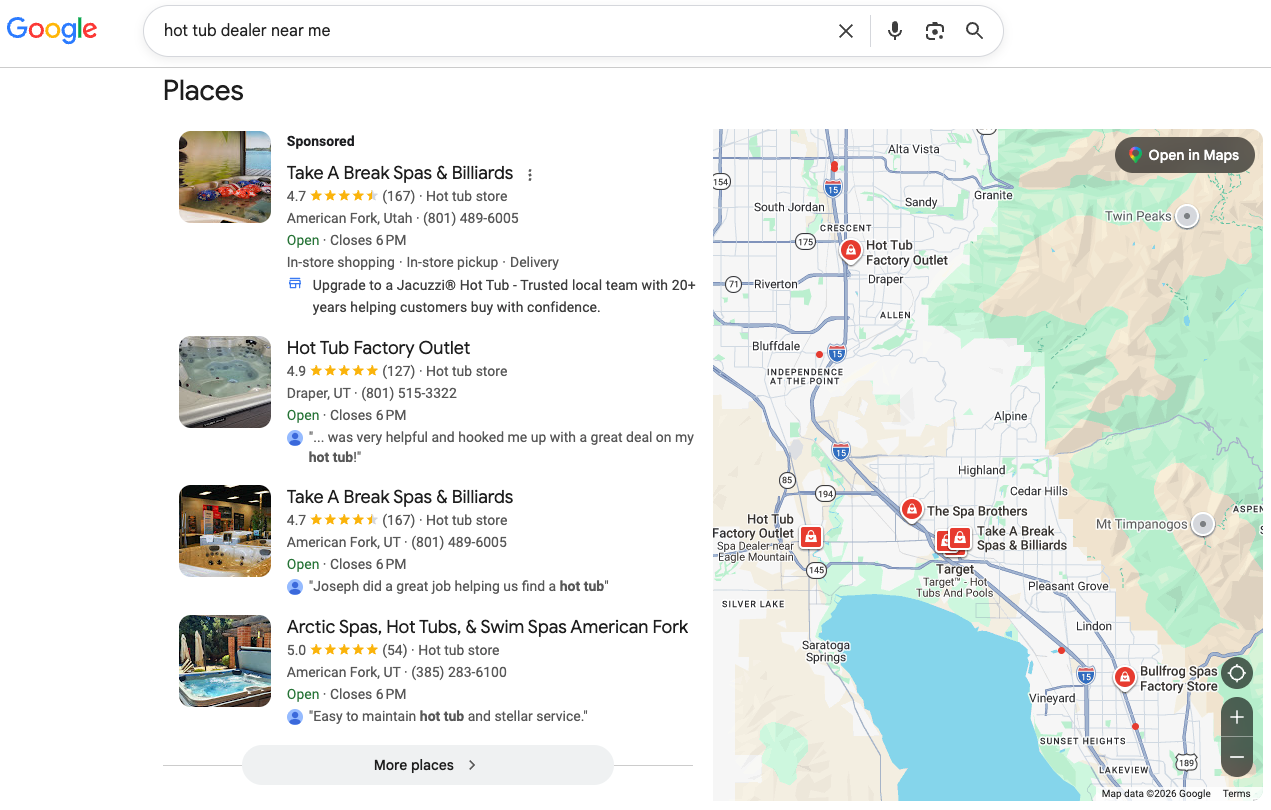
Everyone below that fold gets a fraction to none of the attention.
If a dealership isn’t in those top three spots, competitors are capturing business that should be theirs, every single day, whether they realize it or not.
Kristin Ravesloot, our head of digital, sees this pattern constantly:
“A lot of hot tub dealers doing local SEO are only doing one or two things that they believe are gonna move the needle. Either they read a blog post or they were told by someone that these one or two things were the most important things that they could be doing, or they just made an assumption, and that assumption is inherently wrong. There is a framework and a checklist that needs to be followed each and every month in order to drive meaningful value for your Google business profile and your map pack rankings. And ignoring most of them is what’s actually hurting your dealership.”
That framework starts with the basics most dealers assume are already handled correctly, and covers a lot more ground than most dealers realize.
Core Identity Fields
- Business name needs to comply with Google’s guidelines and match the real-world name of the business, not a keyword-stuffed version.
- Categories matter more than most dealers think; a correct primary category paired with relevant, close secondary categories tells Google exactly what kind of business this is and which searches it should surface for.
- Address setup depends on business type.
- Service area businesses should have their address removed from the public profile, while physical storefronts should keep an accurate, visible location.
- Phone number should stay consistent with what’s used everywhere else the business is listed online, whether that’s a direct number or a call tracking number used for marketing attribution.
- Tracking numbers are useful for measuring campaign performance, but it’s worth knowing this can create a slight mismatch with strict name, address, and phone consistency if not handled carefully.
- Hours need to stay current, both standard hours and any additional hours for holidays or seasonal changes, since outdated hours are a fast way to lose trust with a buyer standing outside a locked door.
- Opening date is a small field, but it should be accurate too. It’s one of the most commonly ignored fields on the entire profile.
The Description and Supporting Details
Past the basics sits a second layer most dealers never touch.
The business description, up to 750 characters, is real estate most listings waste on generic language. Remember when I wrote about the “sameness” problem? Yeah, it applies here too. Your description should cover location, who the business is, what it does, its unique selling proposition, when it started, and what industry it operates in. Most dealer profiles either leave this blank or fill it with vague marketing copy that says nothing specific. Please don’t do this.
Attributes, small checkboxes covering amenities, accessibility, “from the business” tags, crowd, parking, payments, and service options, add credibility signals that can influence which searches a profile is eligible to appear in.
Service areas should be set to a realistic radius reflecting where the dealership actually does business, not left at a default setting or ignored entirely, and this field is irrelevant for physical storefront businesses that don’t operate as service area businesses.
The website link should point to the most relevant page, whether that’s a homepage or a dedicated location page, and should include UTM parameters so traffic coming from the profile is clearly trackable in analytics instead of getting lost in unattributed traffic.
An appointment URL, whether through a third-party booking provider or a direct booking link, gives buyers a low-friction way to schedule a consultation or service visit directly from the listing.
Social media profiles round this section out, and every relevant platform should be linked: Facebook, Instagram, TikTok, LinkedIn, YouTube, Pinterest, and X/Twitter.
Contact options matter too. Enabling WhatsApp (yes, I said it) and text message as contact methods gives buyers more ways to reach out without picking up the phone, which some buyers strongly prefer.
Reviews: The Engine Most Dealers Never Turn On
Reviews are one of the strongest signals feeding both map pack rankings and buyer trust, and most dealerships treat them passively instead of running them like a system. That means actively generating more reviews on an ongoing basis, not in a single push, replying to every review, thanking and staying positive on the good ones, apologizing and showing understanding on the negative ones, and flagging fake reviews or fraudulent profiles when they show up.
One caution worth naming directly. Authentic reviews only. I’ve seen some dealers coaching or incentivizing customers to work specific keywords into their reviews. This might sound like a clever tactic, but it edges toward manipulated content in Google’s eyes and carries real risk if it looks orchestrated and you get caught. Don’t do this.
The goal is a strong, sustained rating built from genuine feedback, not an engineered one.
Products, Services, and Activities
Products should be listed individually, one product or service per entry, each with a relevant image and a link back to the corresponding page on the website.
Services should be listed as their own distinct entries too, covering things like installation, delivery, or maintenance plans, rather than being folded into a single vague product listing.
Activities, a feature many dealers have never touched, allow a business to list specific bookable experiences or offerings with a name, description, price, and booking URL. For a dealer running consultations, demo appointments, or seasonal promotions, this is an underused way to give buyers a direct path to action right from the listing.
Photos and Videos
Photos and videos are one of the highest-impact, lowest-effort parts of a profile, and also one of the most neglected. High-quality images should cover interior, exterior, cover, logo, staff, product, team, and identity, giving buyers a real sense of the business before they ever walk in.
These should be uploaded regularly, not dumped once when the profile was first created and left untouched for years. A profile with fresh photos signals an active, well-maintained business, both to Google and to the buyer scrolling through it. I
f this sounds like a lot, give it to the person who runs the front desk… each time we have a new team member join, take a picture and add it. Each time we refresh our point of purchase or promotion signage in store, take a picture and add it.
You get the idea. Just build it into the process and let it rip.
Posts
Posts function similarly to a mini social feed inside the listing itself. Offers, what’s new updates, and event announcements, paired with high-quality images and published on a consistent cadence, keep the profile feeling current. A profile that hasn’t posted anything in over a year reads as inactive, even if the business behind it is thriving.
Fighting Spam
Sometimes a dealership’s map pack position isn’t lost to a stronger competitor at all; it’s lost to a fake or spammy one. Flagging fraudulent competitor listings and using Google’s redressal tools when needed is part of maintaining a fair playing field, and it’s a step most dealers never think to take, even when a suspicious listing is sitting right above theirs.
The Monthly Checklist
Pulling all of this together, here’s what should actually be happening every single month, without deviation:
- Confirm business name, categories, address, phone number, and hours are still accurate.
- Review and refresh the business description if anything has changed.
- Check that attributes, service areas, website link, and appointment URL are current.
- Request new reviews from recent customers and respond to every review received that month, positive or negative.
- Flag any suspicious or fake reviews and competitor listings.
- Upload new photos or videos across at least a couple of the key categories.
- Publish at least a few posts covering offers, updates, or events. Review products, services, and activities to confirm pricing and descriptions are still correct.
None of these individually take long. Together, done consistently, they’re what separates a profile that ranks from one that doesn’t.
Why This Has to Be a Monthly System, Not a One-Time Project
This is the part that actually determines whether any of it works.
A profile cleaned up once and left alone starts losing ground almost immediately, while competitors who post weekly, respond to every review, and keep their content current keep earning the trust signals Google rewards.
This only works as a framework executed every single month, without deviation and without skipping the pieces that feel less urgent. The dealers winning the map pack aren’t necessarily better dealerships. They’re the ones treating their Google Business Profile like an asset that needs ongoing maintenance instead of a listing they set up once and moved on from.
At the end of the day, the map pack isn’t lost to a better competitor; it’s lost to a competitor with a more complete, more consistently maintained profile. That’s a controllable outcome, not a matter of luck or market conditions, and it starts with an honest look at how many of these pieces are actually being executed on right now versus how many have been sitting untouched.
FAQs
Why isn’t my hot tub dealership showing up in the map pack?
Usually it’s not one big issue but a combination of gaps, incomplete categories, a weak or missing description, inconsistent reviews, and infrequent posting, that collectively signal a less active, less trustworthy profile compared to competitors.
What Google Business Profile fields actually affect local rankings?
Categories, business description, attributes, service areas, review volume and recency, and posting consistency all factor into how Google evaluates and ranks a profile for local search.
How often should I be updating my Google Business Profile?
Monthly at minimum, with reviews, posts, and photos ideally touched even more frequently. A profile maintained on a consistent schedule outperforms one that gets cleaned up occasionally.
Is it safe to ask customers to include keywords in their reviews?
No. This can look like manipulated content to Google and carries real risk. Focus on generating genuine, authentic reviews consistently instead.
What should I do if a competitor has a fake or spammy Google Business Profile?
Use Google’s redressal tools to flag it. A fraudulent or duplicate competitor listing can quietly take up map pack space that should belong to a legitimate business.

Greg is the founder and CEO of Stryde and a seasoned digital marketer who has worked with thousands of businesses, large and small, to generate more revenue via online marketing strategy and execution. Greg has written hundreds of blog posts as well as spoken at many events about online marketing strategy. You can follow Greg on Twitter and connect with him on LinkedIn.
